

09 Oct Sustainable Finance: The Role of the Treasurer in Creating Value for the Company
The other day I was able to read PwC’s 2023 Global Treasury Survey, Global Treasury Survey, and I would like to share some general insights with you to encourage you to read it in full and analyze why treasury is now key to driving sustainable value for companies and achieving sustainable finance.
In this edition, the more than 350 respondents from 32 countries confirm that in leading companies, the treasury function not only adds value within its own area, but also drives excellence beyond its own function. This includes optimizing treasury efficiency, strengthening the balance sheet, generating business insights for forecasting, and improving cash flow to manage financial and commercial risks in a way that safeguards the company’s assets.
It is no easy task for the treasurer, who must navigate the complex current environment, marked by high inflation, rising interest rates, and recent banking tensions.
6 Key Areas for Creating Value in Sustainable Finance
The table below effectively summarizes the areas that, in the opinion of treasury managers, add the most value to the company.
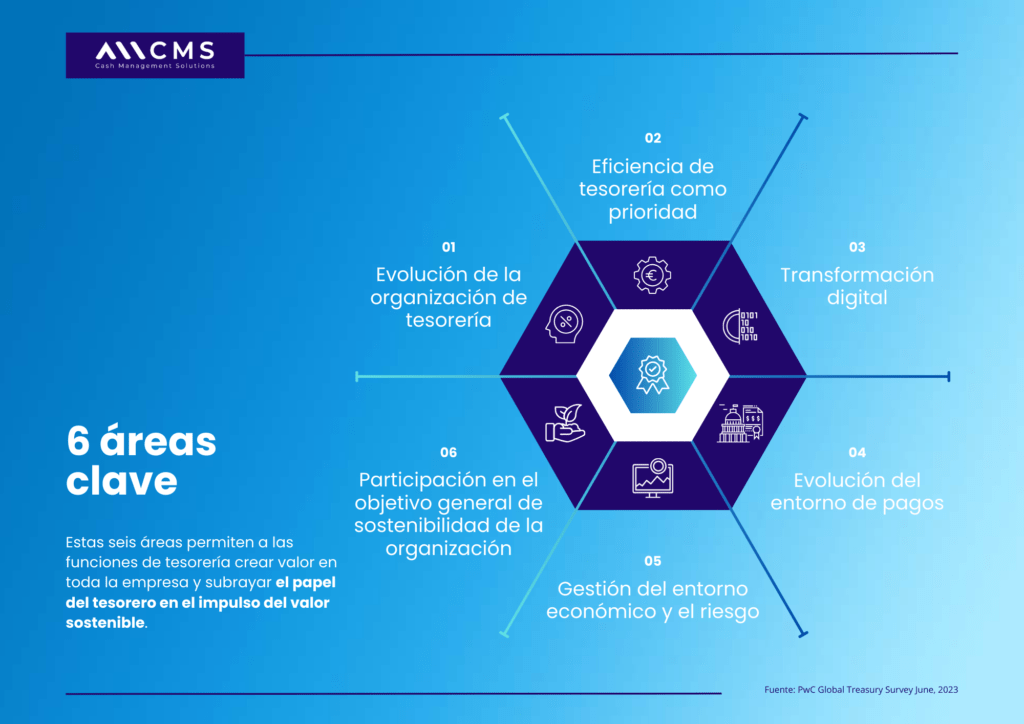
- Treasury is a key ally within the company: The treasury function is evolving to become a strategic partner and strengthen sustainable finance within the company. The added value of this area is no longer exclusive to the finance department, but extends beyond it.
- Addressing cash optimization needs: Treasury, financing, cash flows, and capital management remain the primary focus of treasurers and CFOs as they continue their transformation to leverage available optimization and security solutions (banking relationships, payment factory, internal bank) by building a connected, automated, and integrated treasury function across the entire organization.
- Enhancing the digital experience to accelerate technology adoption: By leveraging management, analytics, and data visualization solutions, strategic treasury organizations gain robust insights to project scenarios with predictive and lasting value.
- Enhancing the fluidity and security of corporate payments: The role of treasurers in payment management is becoming increasingly important. Banking and treasury communication systems help optimize and automate the payment chain to improve control and visibility of cash flows while simultaneously combating fraud and compliance risk. The creation of a payment hub (IHB) contributes to this evolution.
- Adapting risk management to changes in the global macroeconomic context: Financial risks are at the forefront of treasurers’ and companies’ attention due to the sharp fluctuations in raw material and energy costs, the rise in interest rates, and the volatility of financial markets in this inflationary environment.
- Supporting management in implementing the ESG strategy: As organizations adopt sustainability and net-zero commitments, sustainable finance must align with organization-wide strategies, with treasury departments playing a driving role.
Differences in the Priorities of CFOs and Treasurers
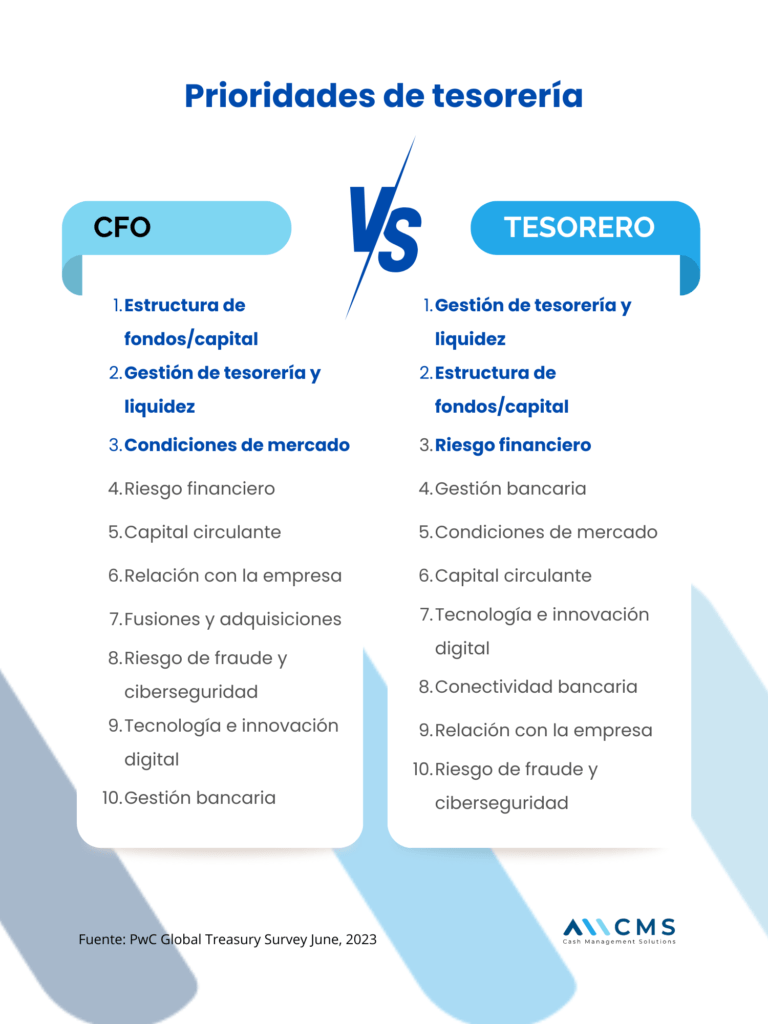
The study also confirms that companies with a more strategic CFO focus on achieving greater shareholder value and generating cash flows above investor expectations.
In all these organizations, the treasury function is critical to responding at all times to business conditions. To achieve this, the use of data, analytics, and automation tools is essential to identify where value is generated today and where it will be generated in the future, focusing on sustainable finance.
Our solutions help improve financial management through services such as:
- Cash Management Solutions
- Payment Portal Solutions
- Accounting
- Risk and Financial Transaction Management
- Bank Connectivity
- Business Intelligence
Some of the companies that trust our expertise